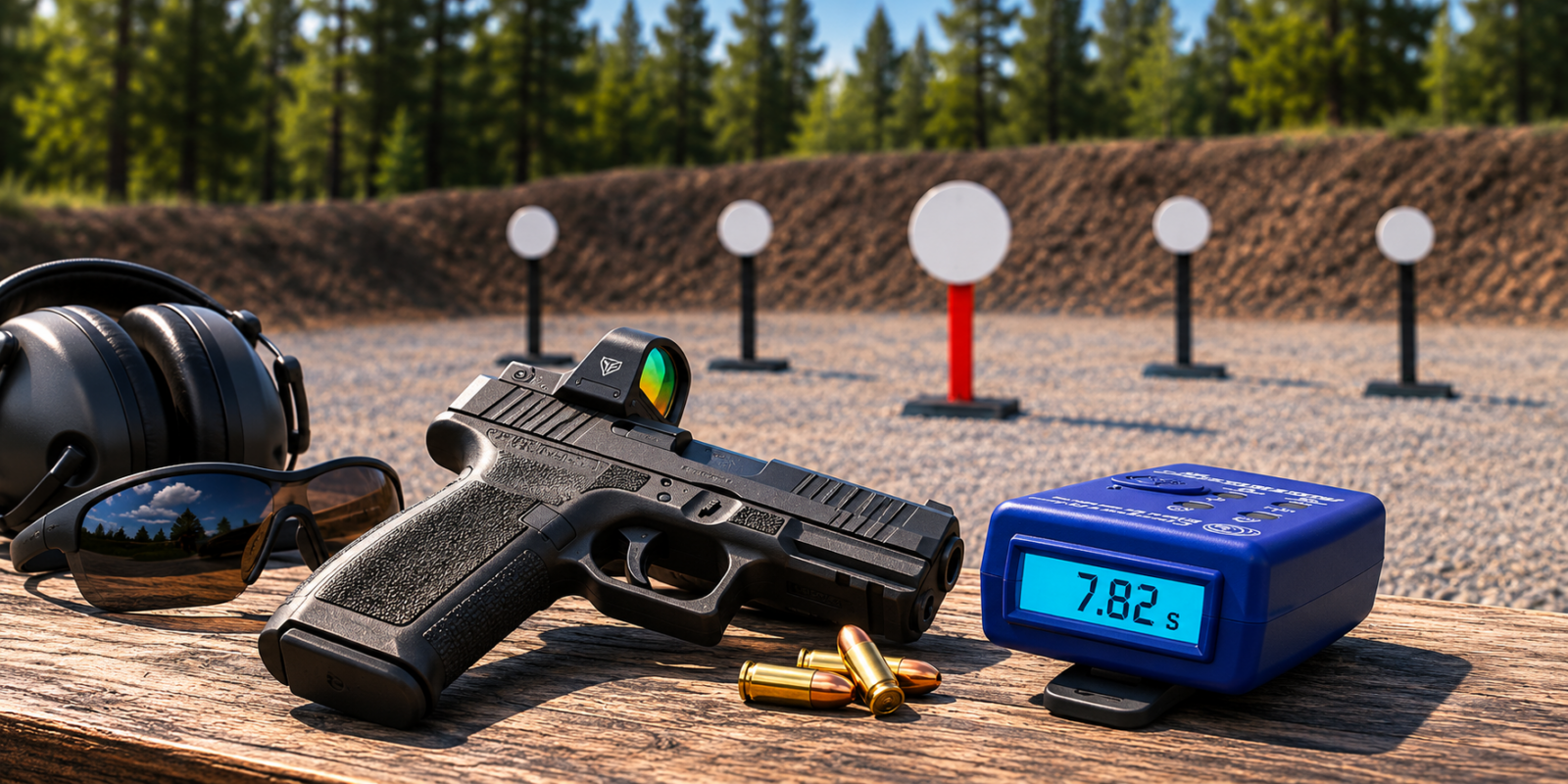

Steel Challenge might be one of the simplest shooting sports to understand. Five steel targets, a shot timer, and a race to hit them as quickly as possible. No complicated stage plans, no reloads on the clock unless something goes wrong, and no debating whether you engaged targets in the correct order.
But once you start looking at classifications, things get a little more complicated.
Unlike IDPA, where classifications are earned through a standardized classifier match, Steel Challenge uses your actual match results to determine your classification. Every time you shoot an official classifier stage, you have an opportunity to improve your standing.
The part that confuses a lot of shooters is how those times turn into a classification percentage. And if you’ve ever shot a personal best only to see your classification barely move, there’s a reason for that.
Steel Challenge Classification Levels
Steel Challenge uses six classification levels, ranging from D Class to Grand Master. Your classification is based on how your times compare to established benchmarks called peak stage times.
| Classification | Percentage |
|---|---|
| Grand Master (GM) | 95% and above |
| Master (M) | 85% to 94.99% |
| A Class | 75% to 84.99% |
| B Class | 60% to 74.99% |
| C Class | 40% to 59.99% |
| D Class | Below 40% |
These percentages aren’t based on where you finish in a match. You could win your local match and still be a B Class shooter, or finish several places down while shooting a Master-level time.
Your classification measures your performance against established stage benchmarks, not the shooters standing next to you.
What Are Steel Challenge Peak Times?
Every official Steel Challenge stage has a peak time for each shooting division. Think of it as the benchmark used to measure how fast you’re shooting.
For example, let’s say a stage has a hypothetical peak time of 10.00 seconds in Carry Optics. If you shoot the stage in 12.50 seconds, you’ve performed at 80% of peak time.
The calculation is simple:
Peak Time ÷ Your Stage Time × 100 = Classification Percentage
10.00 ÷ 12.50 × 100 = 80%
That’s A Class performance on that particular stage.
If you shoot the stage in 10.00 seconds, you’ve matched the peak time and earned a 100% performance for that stage. Shoot it faster than the peak, and your calculated percentage can exceed 100%.
Peak times vary by division. A rimfire rifle and a centerfire pistol aren’t expected to produce the same times, so each has its own benchmarks.
How Your Overall Classification Is Calculated
Here’s where Steel Challenge gets interesting.
Your classification isn’t determined by averaging the individual percentages from every stage. Instead, SCSA adds together your best qualifying times for each official stage you’ve shot, then divides the combined peak times by your combined stage times.
Let’s use a hypothetical Carry Optics shooter who has completed four different classifier stages. The peak times below are illustrative, not official SCSA peak times.
| Stage | Example Peak Time | Shooter’s Time |
|---|---|---|
| Smoke & Hope | 10.00 | 12.50 |
| Roundabout | 9.75 | 13.00 |
| 5 to Go | 12.50 | 16.00 |
| Showdown | 9.75 | 12.00 |
| Total | 42.00 | 53.50 |
42.00 ÷ 53.50 × 100 = 78.50%
That shooter would be classified as A Class in Carry Optics.
As additional official stages are completed, those stages become part of the calculation. Once you’ve shot all eight, your classification reflects your performance across the entire set rather than just a handful of stages.
You need results from at least four different official stages in a division to earn a classification.
Calculate your Classification here with our free Steel Challenege Classification Calculator tool
Select your division and enter your best eligible total match time for each official classifier stage. Leave stages you haven’t shot blank. This is an unofficial GunCraver estimate, not an SCSA classification lookup. Enter the aggregate match stage time (best 4 of 5 strings, or best 3 of 4 for Outer Limits), not an individual string. Enter the best eligible score for each stage from the current and previous two calendar years. DNF default totals (120 seconds for five-string stages; 90 for Outer Limits) are excluded. Results may differ from your official record due to score validity, match reporting, score windows, historical classifications, or later changes to peak times. Official data: SCSA classifications & peak times · Read GunCraver’s classification guideSteel Challenge Classification Calculator
Official stage Peak time Your time (sec) Stage %
SC-1015 to Go
—
—
SC-102Showdown
—
—
SC-103Smoke & Hope
—
—
SC-104Outer Limits
—
—
SC-105Accelerator
—
—
SC-106The Pendulum
—
—
SC-107Speed Option
—
—
SC-108Roundabout
—
—
Does Every Match Count Toward Classification?
Not necessarily.
Steel Challenge currently has eight official classifier stages:
- 5 to Go
- Showdown
- Smoke & Hope
- Outer Limits
- Accelerator
- The Pendulum
- Speed Option
- Roundabout
Only eligible results from official classifier stages count toward your classification. A club can build a fun five-plate stage of its own, but that doesn’t automatically make it a classifier.
The match also needs to be properly reported to SCSA, including payment of the required activity fee.
Another important detail is that Steel Challenge uses your best qualifying stage time, not your average across every match you’ve shot.
Let’s say you shoot Roundabout in 15 seconds at one match, then return a month later and shoot it in 13 seconds. The faster qualifying time replaces the slower one in your classification calculation.
That gives shooters a reason to keep returning to the same stages. A bad match doesn’t permanently ruin your classification, and a great run can keep helping you long after the match is over.
Why Your Classification Percentage Can Go Down
This catches some shooters by surprise.
Steel Challenge uses qualifying stage results from the current calendar year and the previous two calendar years. As older scores fall outside that window, they can stop contributing to your classification.
Your percentage can also change as you add results from additional stages. If you’re strong on Smoke & Hope and Roundabout but struggle with Outer Limits, adding Outer Limits to your record might pull your overall percentage down.
However, there’s an important distinction between your classification percentage and your earned classification letter.
Your percentage can decrease, but once you’ve earned a classification level, you won’t be downgraded to a lower class.
So if you’ve earned A Class and your calculated percentage later drops into B Class territory, you retain your A classification.
SCSA recalculates classifications weekly, generally early Wednesday morning, so don’t expect a new personal best on Saturday to appear immediately.
How to Improve Your Steel Challenge Classification
There’s an obvious answer: shoot faster. But improving your classification is more about consistency than trying to set a personal record on every string.
On most Steel Challenge stages, you shoot five strings and your slowest is thrown out. Outer Limits is different, with four strings and the slowest discarded. That means one bad string doesn’t necessarily destroy your stage time, but two bad strings can get expensive.
We’ve all had a stage where the first few strings felt great, only to throw away several seconds with a missed plate or a rushed transition. Those mistakes add up quickly.
If you’re trying to move up a class, look at your individual stage results rather than obsessing over your overall percentage. Find the stages where you’re furthest from the peak time and work on those.
For some shooters, that’s going to be Outer Limits because of the movement between shooting boxes. For others, it might be The Pendulum or Speed Option, where target transitions and accuracy can eat up time.
And don’t overlook the value of simply shooting more official stages. If your club runs the same two or three stages every month, traveling to a match that offers different classifiers can help you build a more complete classification record.
What About the Two New Steel Challenge Stages for 2027?
SCSA recently announced that two new stages, DVC and Peek-a-Boo, have been selected for provisional use beginning January 1, 2027.
We previously covered the eight provisional stage candidates and the selection of the final two.
The new stages won’t immediately have established official peak times. Instead, SCSA plans to collect match results throughout 2027 and use that data to establish the benchmarks.
At the end of 2027, those peak times are expected to be applied to individual stage results, with classification adjustments beginning in 2028.
For now, the existing eight official classifier stages remain the foundation of Steel Challenge classification.
Where to Check Your Steel Challenge Classification
You can look up your classification through the official SCSA classification system.
Your record shows your classifications by division, qualifying stage times, peak times, and the scores contributing to your current percentage.
It’s worth checking after a match, especially when you’ve improved on a stage you haven’t shot particularly well in the past.
Steel Challenge has a way of making small improvements feel pretty significant. Shaving half a second off a stage might not sound like much, but across several stages, those improvements can be the difference between staying in your current class and finally earning that next letter.
And once you’ve earned it, there’s always another classification waiting to chase.




Leave a comment