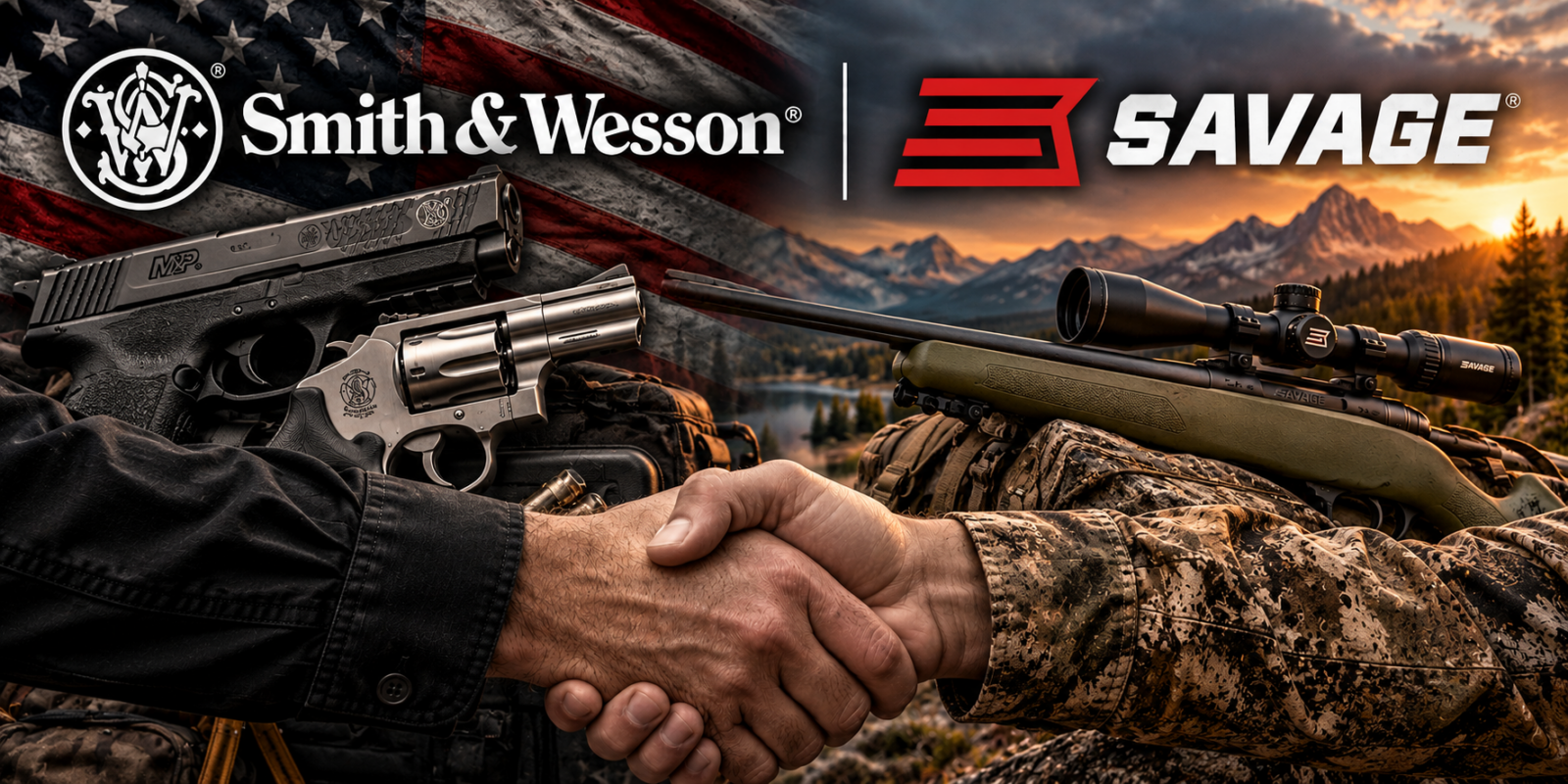

Two of the oldest names in American firearms are now under the same roof. On October 21, 2026, Smith & Wesson announced it had completed the acquisition of Savage Arms for $160 million, bringing together two manufacturers with more than 300 years of combined history.
At first glance, it might seem like another large firearms company buying a competitor. But this deal makes quite a bit of sense when you look at what each manufacturer brings to the table.
Smith & Wesson has built its reputation around revolvers, semi-automatic pistols, and more recently, modern sporting rifles. Savage, on the other hand, has spent decades building its name around affordable, accurate bolt-action rifles, rimfires, and hunting firearms.
Both companies have their strengths, and neither has been particularly dominant in the other’s strongest markets. That’s what makes this acquisition interesting.
A $160 Million Deal
Smith & Wesson purchased Savage Arms from an affiliate of JDH Capital, the investment firm that previously owned the company.
The $160 million transaction wasn’t entirely cash. Smith & Wesson issued approximately 9 million shares of common stock valued at $13.62 per share, along with $37.5 million in cash. As part of the agreement, JDH Capital now owns approximately 16.7% of Smith & Wesson, making it the company’s largest shareholder. JDH also received a seat on Smith & Wesson’s board of directors.
Savage wasn’t exactly a small operation before the acquisition. The company generated approximately $160 million in net sales over the 12 months ending September 30, 2026. Smith & Wesson expects the acquisition to contribute roughly $18 million in additional annual earnings before interest, taxes, depreciation, amortization, and stock-based compensation, before further potential savings from combining operations.
Those numbers explain why Smith & Wesson was interested, but the bigger opportunity may be what Savage adds to its existing product lineup.
Smith & Wesson Has Always Been Strong in Handguns
Smith & Wesson doesn’t need much of an introduction. The company has been making firearms since 1852 and has become one of the most recognizable names in the industry.
Its M&P pistol lineup has been particularly successful in the defensive handgun market, competing directly with Glock, SIG Sauer, and other major manufacturers. The Shield series has also been a popular choice for concealed carry, while the company’s revolvers continue to maintain a loyal following.
Smith & Wesson has also made a name for itself in the modern sporting rifle market with the M&P15 lineup, and more recently has expanded its offerings with products like the Response pistol-caliber carbine and its lever-action Model 1854.
The company certainly isn’t limited to handguns anymore.
But there’s one area where Smith & Wesson hasn’t had the same presence: traditional hunting rifles.
That’s where Savage comes in.
Savage Fills a Pretty Big Gap
Savage Arms has been building rifles since 1894, and for many hunters, the brand is practically synonymous with affordable accuracy.
The Savage Model 110 has been around for decades and remains a familiar choice for hunters looking for a dependable bolt-action rifle without spending a fortune. The Axis lineup brought that same approach to the entry-level market, while rifles like the 10/110 series and specialized precision models have found their way into competitive and long-range shooting.
Savage also has a strong presence in rimfire firearms with models like the Mark II and A Series, along with shotguns and other hunting products.
Perhaps one of Savage’s biggest accomplishments has been making accurate rifles accessible to everyday shooters. Features like the AccuTrigger helped the company build a reputation for delivering performance at a reasonable price.
Smith & Wesson could certainly develop its own bolt-action hunting rifle lineup, but that would take years of development, marketing, and building customer confidence.
Instead, it just bought a company that has already spent more than 130 years doing exactly that.
And Savage gains something too. Smith & Wesson brings manufacturing resources, established distribution relationships, and the financial backing of a much larger publicly traded firearms company.
If handled correctly, the combination could benefit both brands without either having to abandon what made it successful.
What Happens to the Savage Arms Brand?
For Savage owners, the good news is that Smith & Wesson has not announced plans to discontinue the Savage name or replace its existing product lines.
The company’s acquisition announcement specifically highlights Savage’s history, reputation, and established position in the hunting market. That suggests Smith & Wesson sees value in keeping Savage recognizable rather than simply absorbing its products into the Smith & Wesson lineup.
At least for now.
It’s important to remember that an acquisition announcement isn’t the same thing as a long-term business plan. Smith & Wesson has discussed opportunities to improve operating efficiency and combine resources, but it hasn’t publicly detailed every change that could eventually come from the acquisition.
We don’t yet know whether Savage’s manufacturing operations will remain exactly as they are, whether product lines will be consolidated, or how much independence the company will maintain over the next several years.
We’d like to see Savage continue operating under its own name, with its own engineering and product development. There isn’t much reason to spend $160 million acquiring a recognizable rifle manufacturer only to strip away the identity that made it valuable.
But corporate decisions aren’t always made with the same priorities as the people buying the guns.
The Bigger Opportunity for Both Companies
One of the more interesting possibilities is how the two companies could use each other’s experience to develop future firearms.
Savage has decades of experience building accurate bolt-action rifles at competitive prices. Smith & Wesson has extensive experience with handgun manufacturing, modern sporting rifles, and large-scale production.
There’s potential for shared engineering, improved manufacturing efficiency, and possibly new products that wouldn’t have made as much sense for either company to develop independently.
We wouldn’t be surprised to see Smith & Wesson lean more heavily into hunting and precision shooting over the next several years. With Savage now part of the business, it has an established foothold in those markets without having to start from scratch.
Of course, there’s also the possibility that Smith & Wesson simply allows Savage to continue doing what it already does well.
That might actually be the better approach.
Savage has a loyal customer base, and changing too much could do more harm than good. The brand doesn’t need to become another Smith & Wesson product line to justify the acquisition.
For now, we see this as a smart move for Smith & Wesson. It adds a respected rifle manufacturer, expands the company’s reach into hunting, and gives it access to an established lineup of products that complement its existing firearms.
The acquisition is complete, but the real test will come over the next few years as Smith & Wesson decides how Savage fits into its long-term plans.
We’re hoping that means better products, more innovation, and continued competition in the hunting rifle market. The last thing shooters need is fewer choices.
Sources
Smith & Wesson Official Acquisition Announcement
Smith & Wesson SEC Filing and Acquisition Details



Leave a comment